01 — POSITION
Ride, mapped.
Follow your route with GPS traces and a speed profile that smooths the noise without losing the shape of the ride.
VELOCITY TRACE00:42:18
Ride recording is designed to work offline. GPS and device sensors provide the core ride data; an internet connection is not required to record a session.
Pacerift is free to use, with no subscription paywall and no display advertising.
A phone can estimate motion, but a handset is not a chassis reference. Vibration, mounting and centripetal acceleration limit reliable absolute lean measurement. The hard-mounted Pacerift Compact Pod is designed for direct chassis sensing.
Pacerift is built around on-device ride recording and local data privacy. No cloud account is required to start recording.
Turn a phone into a clear view of your ride. Record first; make sense of the details after you park.
Follow your route with GPS traces and a speed profile that smooths the noise without losing the shape of the ride.
Review acceleration, braking load and peak G after every session.
See how your pace, smoothness and ride patterns shape your own profile.
Choose from a garage of 4,000+ motorcycle specifications, or add a custom build.
Browse the garage ↗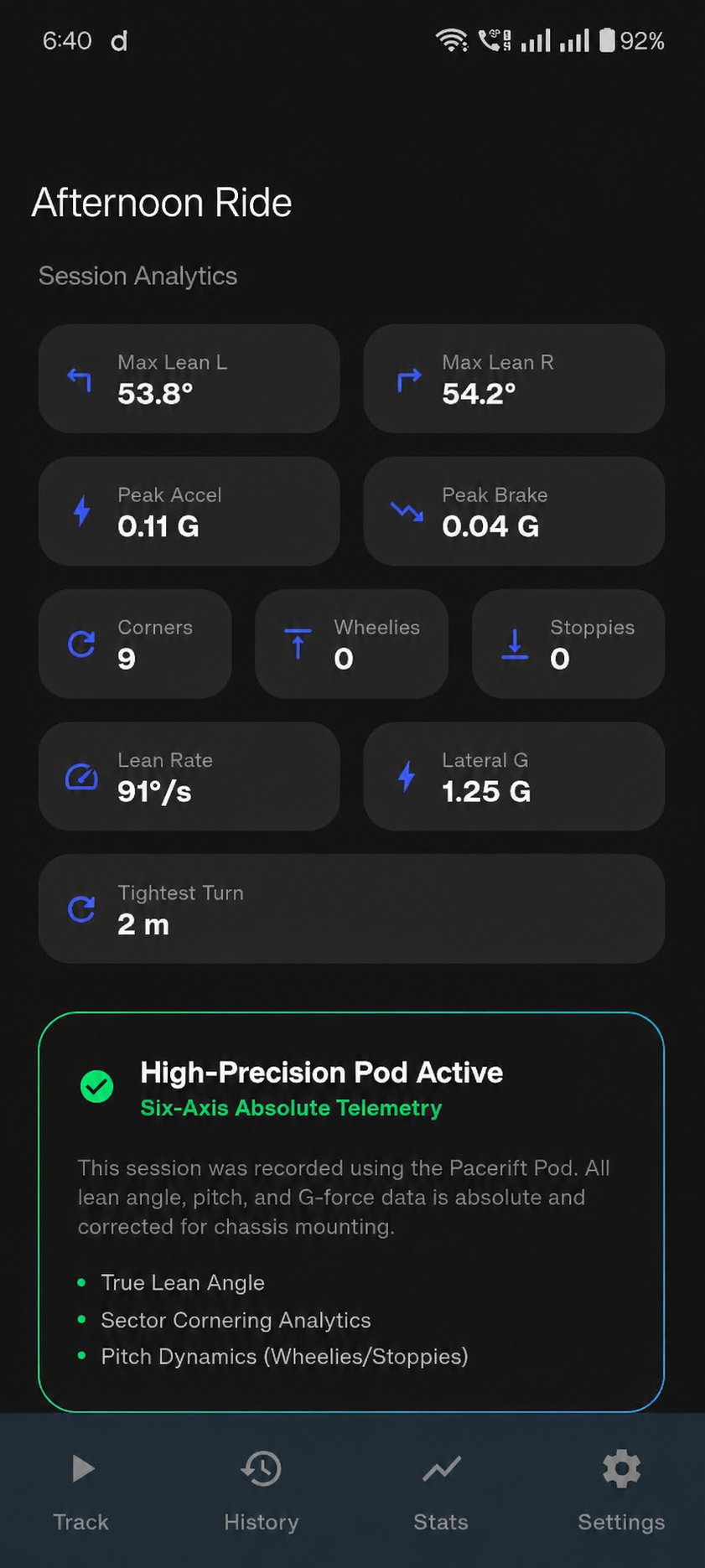
Engineering notes for riders who want to understand how GPS and inertial signals become a readable ride profile. These are processing concepts, not a claim that a phone replaces calibrated chassis-mounted motorsport instrumentation.
A low-pass Butterworth response attenuates high-frequency noise while retaining the ride-scale motion that matters. For order n and cutoff fc, the squared magnitude response is:
|H(jω)|² = 1 / (1 + (ω / ωc)2n)Cutoff selection trades noise rejection against transient response. Filtering should preserve acceleration and braking events rather than over-smooth them.
For samples in a local window, compute the median m and median absolute deviation (MAD). Flag an outlier when:
|xᵢ − m| > k · 1.4826 · MADThe scale factor makes MAD comparable to standard deviation for normally distributed noise. A flagged sample can be replaced with the window median or marked for downstream handling.
Orientation quaternions rotate measured acceleration from device coordinates into a chosen reference frame:
aworld = q ⊗ adevice ⊗ q⁻¹Gravity compensation and axis alignment help estimate linear acceleration. Orientation drift and phone placement remain sources of uncertainty.
Longitudinal acceleration is estimated from velocity change over time. For a turn at speed v and radius r, lateral acceleration is:
alat = v² / r G = a / 9.80665 m·s⁻²An ideal coordinated-turn lean estimate follows tan(θ) = v²/(r·g). Phone-only estimates are affected by mounting, vibration, road camber, tire dynamics and sensor drift.
PHONE SENSORS SUPPORT RIDE ANALYSIS · THE OPTIONAL PACERIFT POD IS DESIGNED TO ADD DIRECT CHASSIS MEASUREMENT
FREE · OFFLINE READY · ANDROID
Open the Google Play listing on your Android phone.
PACERIFT / GOOGLE PLAYOpen Google Play ↗